Product Introduction
Product Positioning
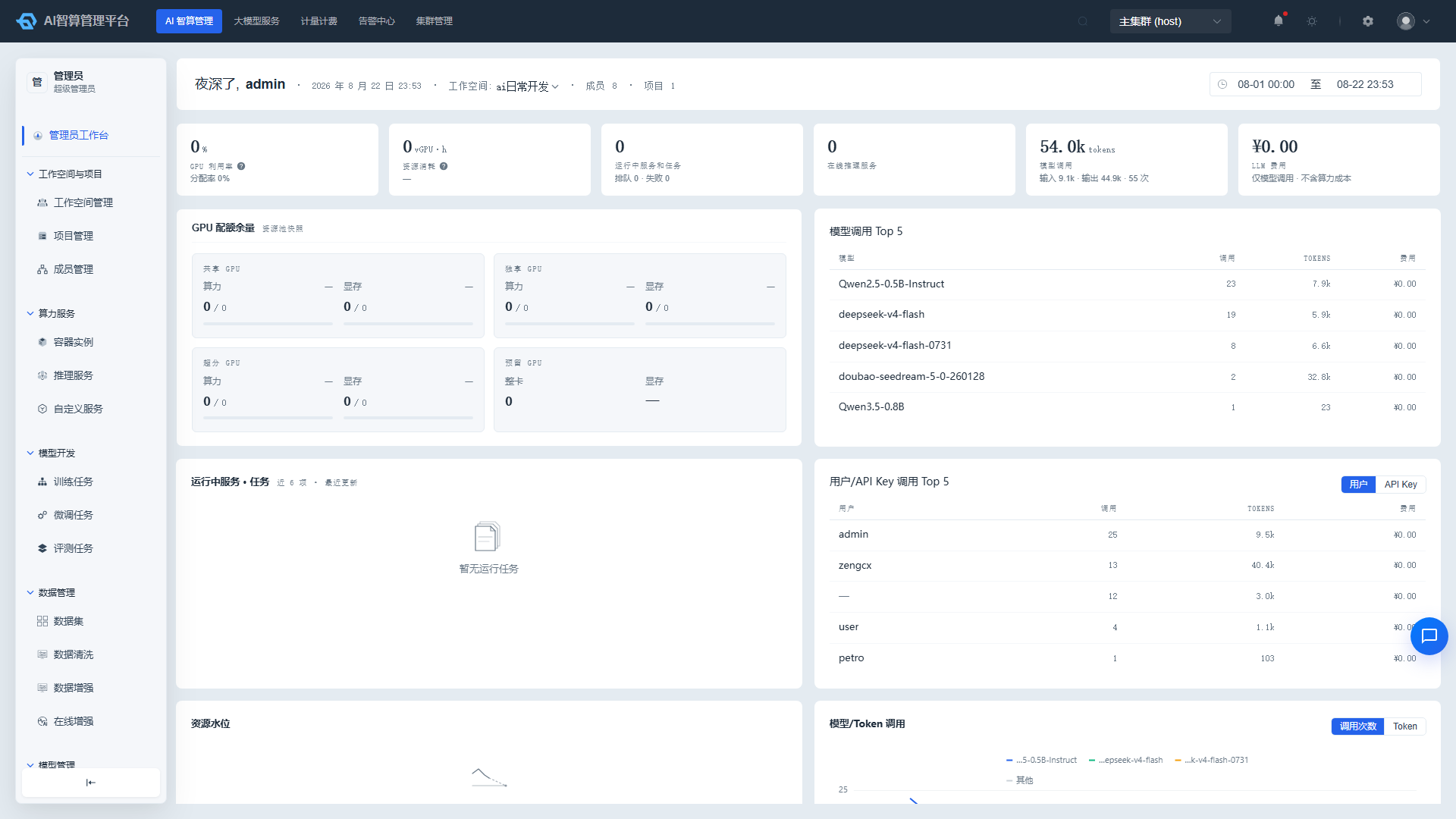
The Rise AI Compute Platform targets enterprise AI compute scenarios, helping algorithm teams, operations teams, and platform operations teams efficiently manage heterogeneous GPU compute, model services, data assets, and costs.
AI compute demand continues to grow, and enterprises commonly face challenges such as low GPU resource utilization (whole-card exclusive in passthrough mode), insufficient elasticity, fragmented multi-vendor hardware ecosystems, and the inability to schedule and manage resources uniformly. The Rise AI Compute Platform implements compute resource pooling through the philosophy of "software-defined GPU compute," delivering cross-vendor, vendor-neutral heterogeneous compute unified management and dynamic delivery capabilities.
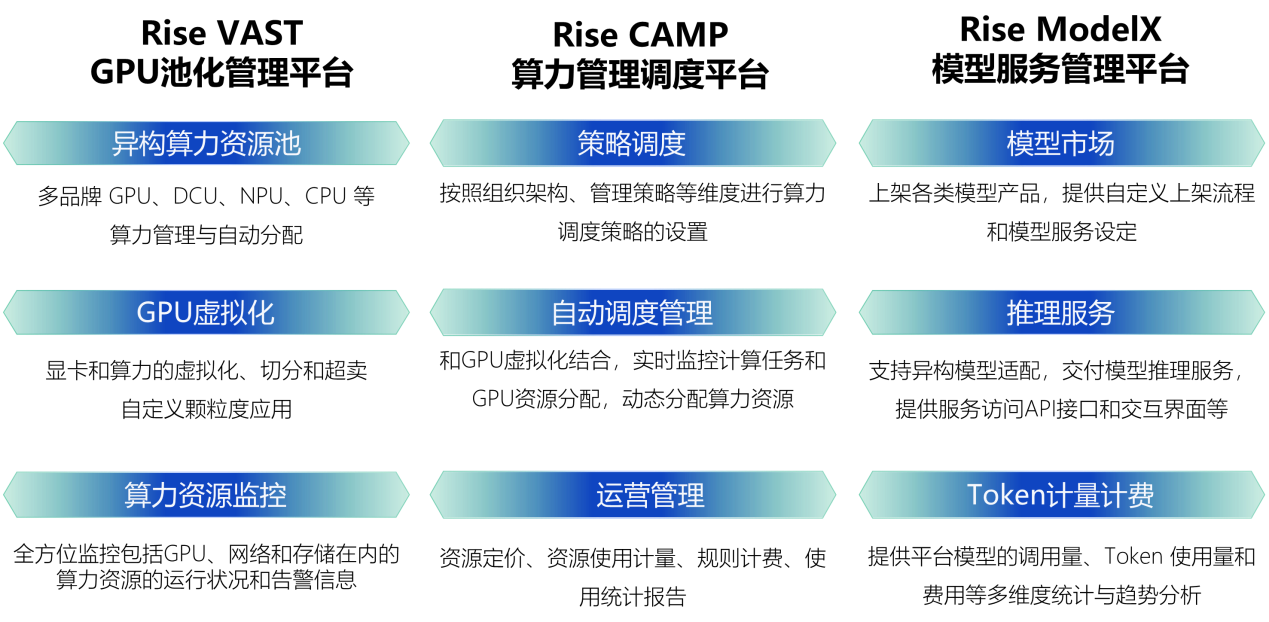
The Rise AI Compute Platform includes four product modules by default, and the feature descriptions in this documentation cover all module capabilities:
| Module | Positioning |
|---|---|
| Rise VAST | Compute pooling foundation: heterogeneous GPU card partitioning and oversubscription, heterogeneous compute resource monitoring, unified management of mainstream domestic and international GPU/NPU compute cards |
| Rise CAMP | Compute management platform (Console): resource scheduling and management interface based on pooled compute; the User Interface and Admin Console documented here are powered by it |
| Rise ModelX | Model management: model marketplace and model playground, supporting custom listing/delisting, one-click deployment (vLLM/SGLang/MindIE engines, etc.), multi-dimensional call volume and Token statistics |
| Rise Router | Large model API gateway: unified access to model services from different vendors and frameworks, providing a unified external API, supporting intelligent routing, service degradation, canary deployments, rate limiting with quotas, and multi-tenant authentication |
What Can I Do with the Rise AI Compute Platform?
| Role | Typical Scenarios |
|---|---|
| Algorithm Engineer | Request GPU compute, run Jupyter/VS Code development environments, submit distributed training and fine-tuning jobs, deploy inference services. |
| Data Engineer | Create datasets, perform data cleaning and augmentation, prepare training corpora. |
| AI Application Developer | Discover models in the model marketplace, one-click deploy, online Playground, invoke inference APIs. |
| Project/Tenant Administrator | Manage teams and projects, configure quotas and resource pools, view resource and task running status. |
| Platform Operations | Onboard K8s clusters, configure alert rules and on-call schedules, monitor GPU/node/task status. |
| Platform Operations/Finance | Analyze tenant resource costs, Token call costs, API channel costs, and formulate billing strategies. |
Two Console Interfaces
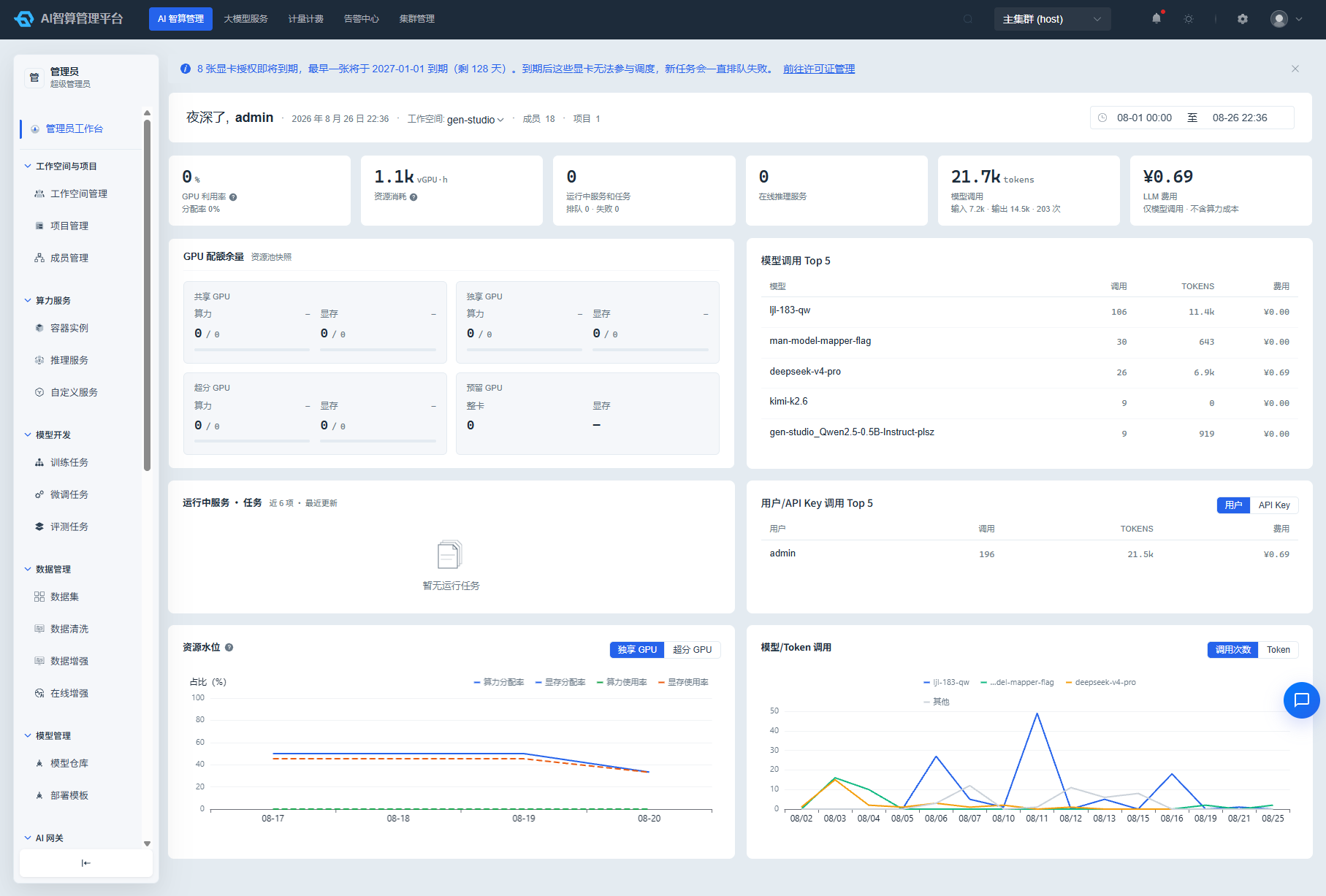
The Rise AI Compute Platform provides two entry points split by user role; the top navigation and left menu you see after login will differ:
| Entry Point | Address | Primary Users | Core Capabilities |
|---|---|---|---|
| AI Compute Development Platform | /camp/login | Algorithm engineers, data engineers, AI application developers | My Workbench, Compute Services, Model Development, Data Management, AI Assets, Large Model Services Online Playground |
| Admin Console | /camp/admin/login | Project/tenant administrators, platform operations, platform operations/finance | AI Compute Management (workspace/project/member/resource/policy), Metering & Billing, Alert Center, Platform & Cluster Management, K8s Cluster Management |
The same account system can be used to log in to both entry points; the menus you can see are determined by your account's role and permissions. Regular users logging in to the AI Compute Development Platform can typically only manage their own tasks and services; administrators logging in to the Admin Console can view and manage multiple workspaces, projects, and cluster resources.
Product Advantages
- Vendor-neutral GPU resource management: Cross-vendor heterogeneous GPU compute resource pool management, supporting resource scheduling, topology-aware scheduling, multi-cluster scheduling, and online/offline co-location, significantly improving compute utilization.
- Flexible compute management strategies: Topology-aware scheduling for NVIDIA, Ascend, Kunlun, Enflame, MetaX, and other cards; priority systems to protect critical tasks; distributed schedulers supporting large-scale batch training and inference.
- Multi-cluster multi-tenant architecture: Flexible compute quota allocation at the workspace/project level; a single resource pool can form a heterogeneous pool from specific cards on different nodes; unified multi-cluster management with separation of control and compute planes.
- GPU resource oversubscription (NVIDIA/Ascend/Kunlun): Compute and VRAM oversubscription (virtual VRAM) improve resource utilization while maintaining task stability and overall throughput.
- Enhanced security and isolation: Secure isolation of user data and compute tasks; multi-level RBAC permissions; full operation audit; API Key call controls.
- High-availability architecture: Automatic fault self-healing; multi-replica component deployment; rolling upgrades with zero downtime.
- Comprehensive performance monitoring: Real-time collection and trend display of GPU compute/VRAM allocation and usage rates, temperature, power, and other metrics.
- Multi-dimensional precise metering and billing: Three billing dimensions — resource (CPU/memory/GPU), physical device (node/GPU card), and model (platform/tenant/user calls, Token) — supporting billing detail views and report exports.
- Unified model management: Commercial and open-source models unified listing/delisting, one-click deployment, Token metering and billing, covering the full lifecycle from model development, training and fine-tuning, to service deployment and operations.
- MCP intelligent analysis: Built-in AI assistant for querying platform information and analyzing logs through conversational Q&A, with chart visualization capabilities.
Product Features
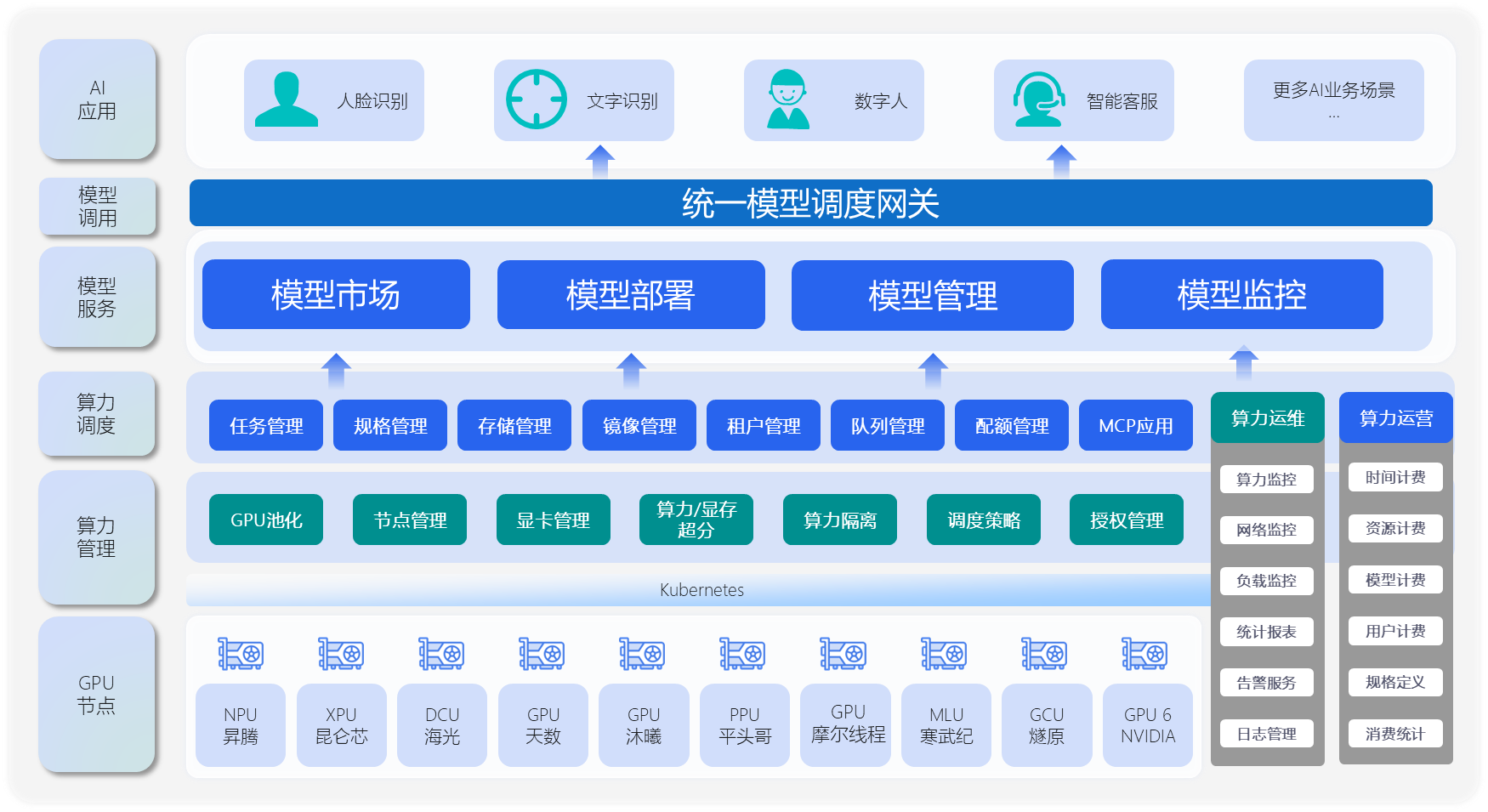
The platform covers the full process from hardware to application: the foundation supports heterogeneous compute from NVIDIA, Ascend, Hygon, Cambricon, and others, improving resource utilization through GPU pooling management; the upper layer provides compute scheduling, task orchestration, and model management to support AI applications across domains; and efficient operations and intelligent management are achieved through compute monitoring and metering and billing.
Heterogeneous Resource Pooling
- Basic resource onboarding: Unified onboarding of NVIDIA, Ascend, Hygon, Cambricon, Enflame compute cards via License authorization; after onboarding, cards can be delivered in various modes: virtualized partitioning, oversubscription, whole-card passthrough, etc. Un-onboarded GPU resources can also be connected to the platform for basic usage monitoring.
- Resource pool management: Abstracts each vendor's GPU virtualization technology for unified resource pooling and allocation in a single management interface; resource pools support flexible partitioning by node or by card.
- Resource quota management: Dual-layer model of tenant management (for AI development teams) and resource pool management (for GPU operations), grouping one or more types of compute cards into logical resource groups to constrain compute and VRAM usage ranges for different departments/teams.
Task Scheduling Management
- Compute flavor management: Custom standardized compute flavors (GPU card model, shared/exclusive mode, vCPU architecture and count, vGPU compute/VRAM) that users select directly when creating inference and training tasks.
- AI development management: Full lifecycle management of three task types — container instances, distributed training, and inference services — covering creation (compute allocation, startup parameters, image/storage configuration), startup, suspend, resume, shutdown, and resource release.
- Intelligent scheduling: A three-layer collaborative mechanism for the full lifecycle of heterogeneous compute — the resource abstraction layer interfaces with vendor Device Plugins to uniformly abstract GPUs/DCUs/NPUs as standard compute units; the intelligent scheduling layer provides topology awareness (NVLink, multi-chip interconnect affinity) and tiered preemption (Volcano priority queues protecting inference SLA, releasing idle capacity to training); the dynamic adaptation layer adjusts oversubscription ratios by hardware type via elastic resource quotas. Scheduling algorithms support first-come-first-served, shortest-job-first, and highest-priority-first, with node-level and GPU-card-level scattered or compact scheduling.
Resource Integration Management
- Image registry management: Integration with Harbor and other image registries; management of OS, container, PyTorch/TensorFlow and other common base images and versions; supporting registry address, credentials, permissions, and enable/disable management.
- Storage service management: Integration with NFS, JuiceFS, Local, and other storage engines; management of capacity, access modes, static/dynamic provisioning, and data storage mount paths, permissions, and enable status.
- Resource capacity observability: Capacity monitoring for clusters, resource pools, and nodes; covering physical GPUs and vGPU devices with report-style task allocation/usage status display.
Model Management
- Model Playground and Model Marketplace: Custom model listing/delisting; model cards filterable by name, inference engine, task scenario, context length, provider, chip vendor, and more; one-click deployment from model card with online conversational experience.
- Model deployment: Support for vLLM, SGLang, MindIE, and other inference engines; model-flavor-engine cross-validation with automatic masking of invalid combinations; deployment templates and custom engine startup parameters; inference services support dynamic autoscaling based on load and scheduled autoscaling; ability to restrict specific users to specific models.
- Model Gateway (Rise Router): Unified access to model services from different vendors and frameworks, providing a unified external API while abstracting away underlying model differences; intelligent routing based on request content, user, and business tags; service degradation (switching to fallback models during failures), A/B testing, and canary deployments; per-user, per-model QPS rate limiting and concurrency quota controls; multi-tenant isolated access credential separation.
- API Key Management: Key creation, distribution, update, disablement, and auditing; complete call logs (call time, caller, request parameters, duration, status code) with time-range filtering; global disable of API Key invocation and anonymous access toggle.
Multi-Tenant Architecture
- Tenant and project management: Tenant creation and resource overview (CPU/memory/shared/dedicated GPU quota allocation and usage); project-level collaboration with task-project binding on creation; batch member addition and role assignment.
- Tenant quotas: CPU and memory total configuration; GPU shared/dedicated mode, card type (vendor and model), oversubscription ratio, and vGPU count with compute/VRAM quotas.
- Resource reclaim: Automatic reclaim of instances, training jobs, and inference services based on VRAM utilization, compute utilization, duration, and other dimensions.
- Flexible compute zones: A single resource pool can form a heterogeneous pool from specific cards on different nodes; tasks select compute zones based on business needs, compatible card types, and pricing; supports differentiated pricing by cluster/tenant with unified settlement.
Operations and Maintenance
- Unified observability: Full-pipeline visibility from the GPU device layer to the K8s task layer — device-level real-time load collection (SM compute time-slice ratio, VRAM usage, inter-board communication traffic), task-GPU binding topology drill-down, platform-level health panorama (utilization watermarks, fragmentation rate, fault card distribution), threshold alerting and automatic fault card isolation, tiered alert notification and remediation closure.
- Resource monitoring and alerting: Health status monitoring for clusters, resource pools, nodes, and vGPU devices, plus AI task running status monitoring; NVIDIA/Ascend detailed fault code tiered alerting (critical/high/medium/low) for fine-grained GPU status control.
- Metering and billing: Multi-dimensional billing strategies for resources (CPU/memory/GPU, minute-level metering), physical devices (nodes/GPU cards), and models (platform/tenant/user calls and Token); real-time billing details, historical summaries, cost trend and proportion analysis, and report exports.
Security Management
- Multi-level RBAC permission system with full operation auditing.
- MFA multi-factor authentication and secondary verification for high-risk operations (login, data deletion, permission changes, and other critical actions), protecting enterprise core assets and operational compliance.
Applicable Scenarios
Inference Scenarios
| Industry | Typical Applications |
|---|---|
| Finance | Real-time bank transaction risk analysis (identifying money laundering/fraud by correlating historical behavior patterns); quantitative securities investment prediction (millisecond-level analysis of massive sentiment and market data). |
| Manufacturing | Production line component visual inspection (parallel inference on batch high-resolution images with high accuracy in detecting scratches and corrosion); predictive equipment maintenance (24/7 analysis of vibration and temperature sensor data with early fault prediction). |
| Energy | Real-time wind turbine acoustic/speed analysis with millisecond-level anomaly protection; parallel processing of tens of TB of reflection wave data in geological exploration and 3D geological structure reconstruction. |
| Healthcare | Rapid CT image reconstruction and multi-dimensional data analysis; large-scale parallel protein folding computation in anti-cancer drug development; compute preemption protection for high-priority tasks such as ECG monitoring. |
| Autonomous Driving | Real-time fused inference of vehicle, pedestrian, and road sensor data with millisecond-level response. |
| Telecommunications | "Central-training-edge-inference" four-tier architecture: headquarters-level unified resource planning and model marketplace, provincial center model debugging and training, edge lightweight model low-latency inference, device-level massive heterogeneous device management — forming a full pipeline of "data localization → model regional training → edge real-time inference → device-level execution." |
Training Scenarios
Enterprise proprietary large model training: During training, hundreds to thousands of GPU cards are typically needed for large-scale distributed training. Before using the platform, compute allocation and invocation strategies relied on manual processes or scripts, with low efficiency and high error rates; after adopting the Rise AI Compute Platform, automated allocation and scheduling of distributed tasks across thousand-card GPU resources is achievable. Through scheduling strategies and queue priority settings, the workload of task deployment and resource scheduling is significantly reduced, delivering standardized and automated compute resource management capabilities.
For detailed technical architecture and component lists, see Product Architecture; for runtime environment requirements, see Runtime Environment; for core concept definitions, see Core Concepts.