Product Architecture
This content is adapted from the "Rise AI Compute Management Platform Technical White Paper" and introduces the technical architecture layers, core components, and AI chip support list of the Rise AI Compute Platform. Runtime environment requirements are covered separately in Runtime Environment.
Technical Architecture
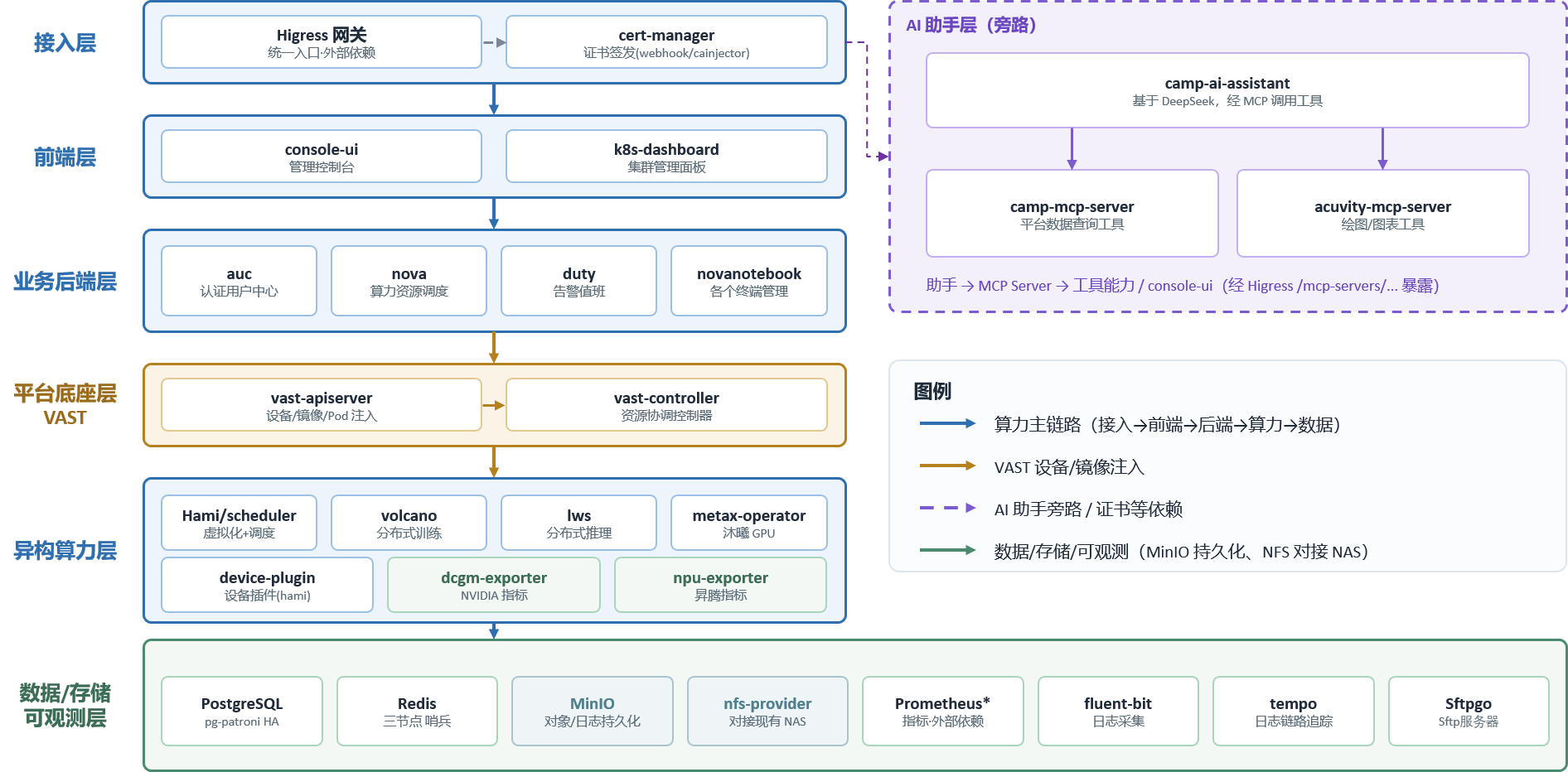
The platform adopts a layered invocation architecture, organized from top to bottom as follows:
| Layer | Description |
|---|---|
| Access Layer | Higress gateway handles all north-south traffic (frontend, business API, MCP Server); cert-manager manages automatic TLS certificate issuance and renewal. |
| Frontend Layer | console-ui management console (Vue 3 micro-frontend), providing two entry points: the AI Compute Development Platform and the Admin Console. |
| Business Backend Layer | auc (authentication and user center), nova (compute resource scheduling engine), duty (alerting and on-call), novanotebook (Notebook and custom service lifecycle Operator). |
| VAST Platform Foundation Layer | Proprietary cloud-native APIServer (vast-apiserver/controller): GPU device management, image registry (Harbor) integration, Pod device resource and pull secret injection. |
| Heterogeneous Compute Layer | GPU/NPU virtualization and scheduling (HAMi), distributed batch scheduling (Volcano, LWS), vendor-specific device-plugins; runtime metrics collected and reported by dcgm-exporter and npu-exporter. |
| Data / Storage / Observability Layer | PostgreSQL (Patroni HA), Redis, MinIO (object storage / log persistence), nfs-provider (NFS dynamic provisioning), Prometheus, fluent-bit (log collection), tempo (distributed tracing). |
| AI Assistant Layer (sidecar) | The platform's built-in chat assistant, powered by a large language model, provides services through MCP tool capabilities delivered via camp-mcp-server and acuvity-mcp-server without interfering with the main pipeline. |
Architecture Highlights
- Unified heterogeneous GPU resource scheduling: Pooling and scheduling of cross-vendor compute resources is implemented at the OS user-space level without modifying the Linux or K8s kernel.
- High-availability architecture: Real-time component health monitoring with automatic restart/rescheduling on failure; separation of control plane and compute plane.
- Rapid iteration: Containerized component delivery with loosely coupled microservices, supporting canary deployments and rollbacks; components can be upgraded independently.
- Multi-architecture deployment: Container images and K8s APIs abstract away underlying differences, supporting cross-cloud, on-premises, and edge deployments on both x86 and ARM architectures.
- Observability platform: Prometheus metrics collection with visualization dashboards covering the full pipeline from device level to task level.
Core Components
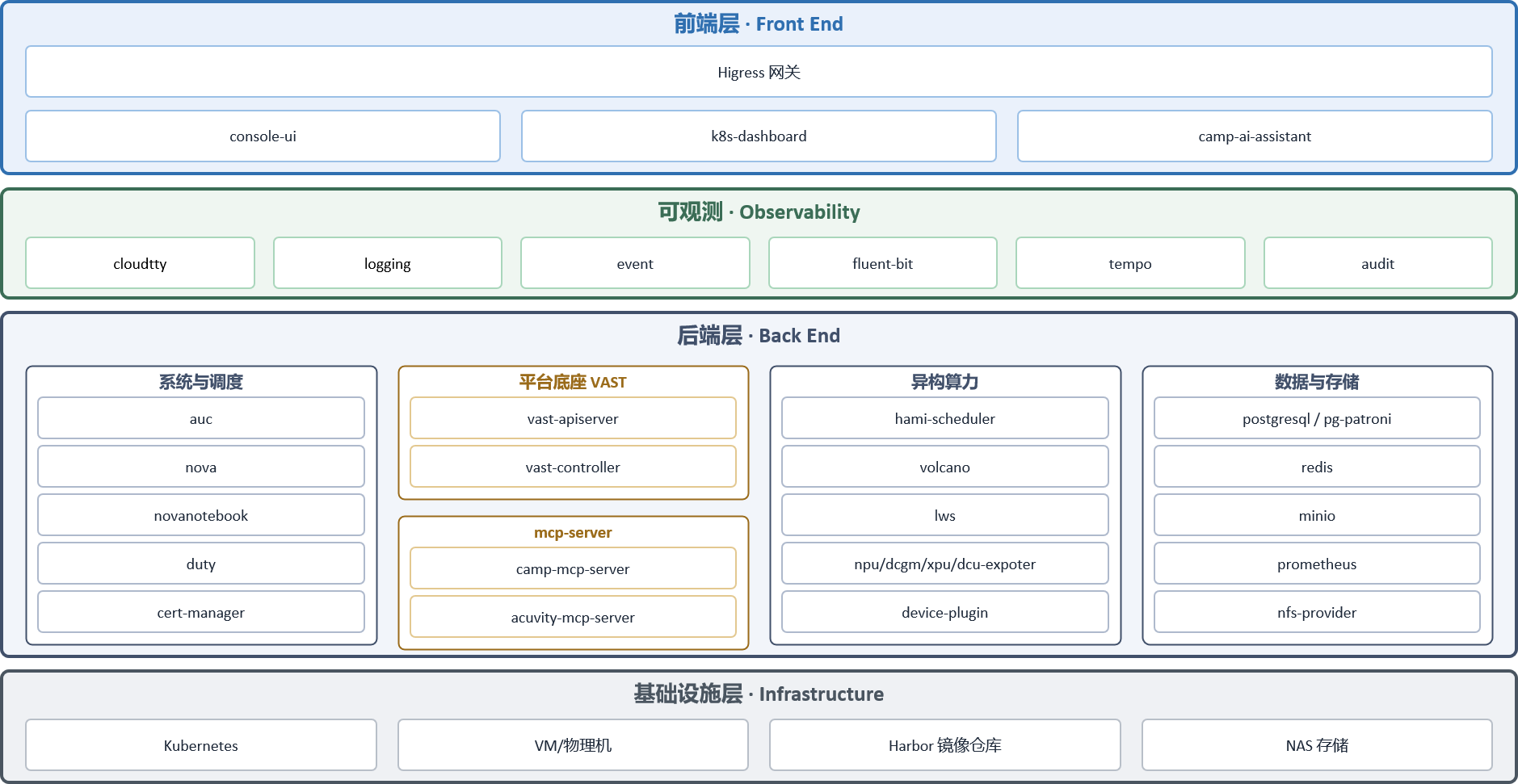
Platform components are organized by frontend, observability, backend, and infrastructure layers:
| Component | Core Functionality |
|---|---|
| Higress gateway | Unified north-south traffic entry point, routing frontend, business API, and MCP Server |
| cert-manager | Automatic TLS certificate issuance and renewal within the cluster |
| console-ui | Compute platform management console, session and login state |
| k8s-dashboard | Multi-cluster node/Pod/storage management with integrated terminal access |
| auc | Authentication and user center, scheduled sync of departments/hosts/clusters |
| nova | GPU/vGPU compute resource management and scheduling engine, resource reclaim/cleanup/billing/fine-tuning training/dataset management |
| duty | Alert and on-call management: alert reception, escalation, shift rotation, notifications |
| VAST (vast-apiserver/controller) | Proprietary cloud-native APIServer: GPU device management, image registry integration, Pod resource injection |
| novanotebook | Notebook and custom service lifecycle management (Operator) |
| cloudtty | Pod/node terminal management |
| sftgo | Model weight/file upload management |
| camp-ai-assistant | Platform AI assistant, invokes tools via MCP |
| camp-mcp-server | Exposes platform data query tools (applications/resources/tasks) to the AI assistant |
| acuvity-mcp-server | Provides MCP tool capabilities such as diagram/chart generation |
| hami | Heterogeneous compute virtualization (vGPU memory/compute partitioning) + scheduler |
| volcano | Distributed training batch scheduling, Gang scheduling |
| lws | LeaderWorkerSet, distributed training Leader/Worker coordination |
| metax-operator | MetaX GPU device management and scheduling |
| device-plugin | Vendor-specific GPU device K8s plugins (GPU/NPU, etc.) |
| dcgm-exporter | NVIDIA GPU metrics collection (DaemonSet) |
| npu-exporter | Ascend NPU metrics collection (DaemonSet) |
| postgresql / pg-patroni | Relational data persistence + high availability |
| redis | Cache/session/queue |
| fluent-bit | Node log collection and forwarding (DaemonSet) |
| tempo | Distributed tracing storage |
| minio | Log and object storage |
| nfs-provider | CSI shared storage integration with NFS, enabling shared file mounts across GPU nodes |
| prometheus | Metrics collection and storage |
Supported AI Chip Vendors
| Vendor | Models | Pooling Support |
|---|---|---|
| NVIDIA | Full product line | Supported |
| Ascend | 310P / 910A / 910B2, B3, B4 / 910C | Supported |
| Hygon | DCU Z100, Z100L / K100, K100_AI | Supported |
| MetaX | XiYun C500 | Supported |
| Cambricon | 370X4, X8 / 370S4, S8 / 590 | Supported |
| Enflame | TianGai BI-V100, BI-V150 / ZhiKai MR-V100 | Supported |
| Moore Threads | MTT S4000 / M1000 | Supported |
| Kunlun | Gen 3 P800 | Supported |
| Enostek | S60 | Supported |
| T-Head | PPU | Supported |
For runtime environment requirements (software dependencies, resource configuration recommendations, deployment topology, OS and AI framework support), see Runtime Environment.